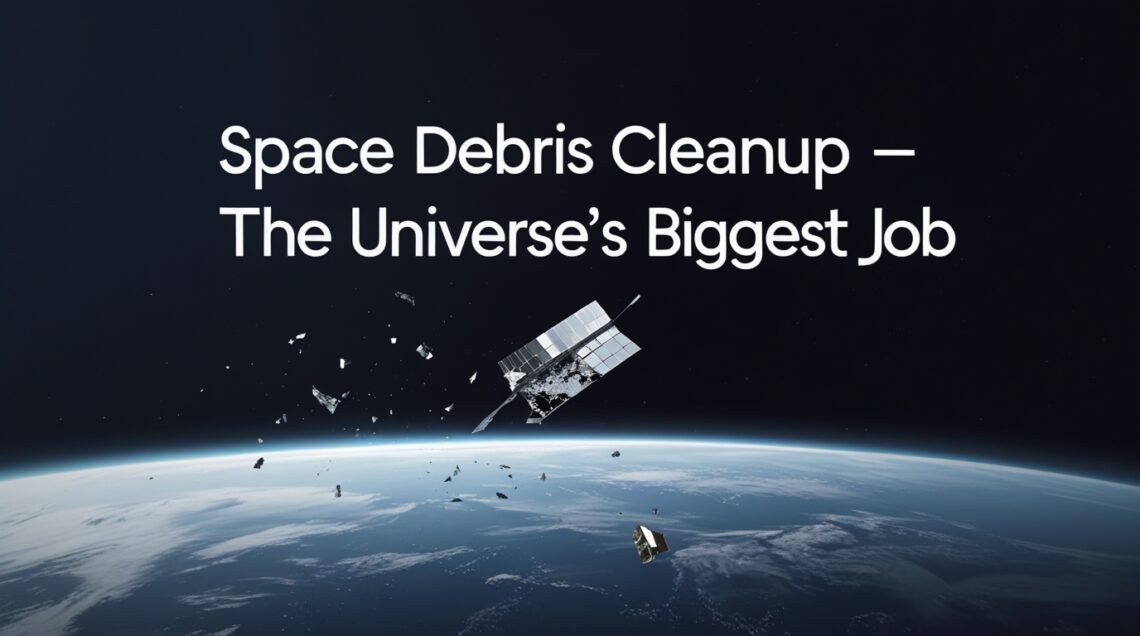
Look, I’ll be straight with you. We’ve made a mess. A big, floating, terrifying mess. Right now, as you’re reading this, millions of pieces of junk are screaming over our heads at 17,500 miles per hour. A fleck of paint hitting at that speed might as well be a bomb. We’re talking about dead satellites, spent rocket stages, a wrench some astronaut dropped in 1985… it’s all still up there. And it’s a game of cosmic bumper cars where a single collision could create thousands of new pieces of shrapnel, potentially triggering a chain reaction that could wipe out our satellites and trap us on Earth. Somebody’s gotta clean it up. And that, right there, is the universe’s biggest, most dangerous, and most critical job.
The Graveyard Over Our Heads:
First off, let’s be clear about what “space debris” actually means. This isn’t just a few loose bolts. The official term is “orbital debris,” and it ranges from the absolutely tiny to the absolutely massive.
- The Tiny Terrors: We’re talking flecks of paint, bits of metal from old explosions or collisions, solid rocket motor slag. Tiny. But at orbital velocity, faster than a bullet, a fleck of paint can crack the windshield of the Space Station. Seriously. They have to replace those windows regularly because of chips.
- The Mid-Sized Menaces: This is the real nightmare fuel. Think of a screw, a bolt, a chunk of a solar panel. Something the size of a marble. At that speed, it has the kinetic energy of a bowling ball dropped from a skyscraper. It would completely obliterate any operating satellite, the International Space Station, or a crewed capsule. There’s no “bulletproof” for that.
- The Big Boys: The real ticking time bombs are the dead, heavy objects. Old rocket bodies the size of school buses, defunct satellites as big as a car. There are thousands of these things. When two of these collide, and they have, it’s not a collision. It’s an explosion. It’s like setting off a grenade in a junkyard, creating a cloud of thousands of new debris pieces, each one a new bullet in the chamber.
This isn’t a future problem. It’s happening now. Every satellite we rely on for GPS, weather, banking, communications, it’s all flying through this shooting gallery. And the scary part? It feeds on itself. More debris leads to more collisions, which lead to even more debris. It’s called the Kessler Syndrome, and it’s the apocalyptic scenario where low-Earth orbit becomes an impenetrable, self-sustaining debris field. We’re flirting with that reality.
Why This is the Hardest Job in the Universe:
Cleaning up Earth is one thing. You send a truck, you pick up the trash. Space? Space is a different beast entirely. The challenges are absolutely brutal.
- The Speed: Everything is moving insanely fast. We’re not talking about gently rendezvousing with a floating object. It’s like trying to catch a specific bullet with another bullet, while you yourself are also a bullet. The precision required is mind-boggling.
- The No-Handholds Problem: There’s no gravity to hold things down. There’s no air resistance to slow things down. A gentle nudge in the wrong direction sends your target spinning off into a new, unpredictable orbit, making it even more dangerous.
- The Identification Problem: Just tracking and identifying a specific piece of debris among millions is a monumental task. Our radar and telescope networks are good, but not that good. Is that a small satellite or a large bolt? The shape, the spin rate, the material, it all matters for figuring out how to grab it.
- The “What Do We Do With It?” Problem: Okay, fantasy time. Let’s say you successfully catch a two-ton dead satellite. Now what? You can’t just put it in a bin. You have to get it out of the way. That means you need enough fuel on your “cleaner” spacecraft to not only chase it down and capture it, but then to drag it down to a point where it will safely burn up in the atmosphere. That requires a monstrous amount of fuel, which makes the whole mission incredibly expensive and complex.
The Wild Tech Trying to Solve This Nightmare:
This is where it gets crazy. Since no one has ever done this before, engineers are throwing every wild idea they have at the wall. It’s like the golden age of invention.
- The Harpoon and Net: Seriously. The British RemoveDEBRIS mission tested this. It literally shot a harpoon at a target and cast a net to capture it. It’s low-tech, but in space, simple is often better. A net doesn’t care if the target is spinning; it just envelops it.
- The Robotic Arm: This is the more precise, delicate approach. A spacecraft carefully approaches and uses a robotic arm to graciously grab the debris. This is what Northrop Grumman’s Mission Extension Vehicles are doing, but for still-working satellites. The tech is there. The problem? It requires incredibly delicate maneuvering and a compatible grabbing point on the debris, which old satellites don’t have.
- The Magnetic Tug: For some newer debris that might have magnetic materials, one idea is to use a powerful magnet to attract and then tow the object without ever physically touching it. Simple, elegant, but limited in what it can grab.
- The Laser Brooms: This is the real sci-fi option. The idea isn’t to vaporize the debris (that would take a crazy amount of energy). Instead, a ground-based or space-based laser would fire precise beams at a piece of debris. The energy from the laser would ablate (burn off) a tiny bit of material from its surface, creating a tiny thrust that would nudge it into a new orbit, ideally, one that causes it to fall into the atmosphere and burn up. It’s like using a photon beam to slowly push a piece of trash off a cliff.
- The Suicide Tug (The Most Likely Hero): The most straightforward method is also the most brutal. A “tug” spacecraft launches, rendezvouses with a big piece of debris, latches on, and then fires its engines in reverse. This acts as a brake, dragging both itself and the debris down into a decay orbit where they both burn up together in a final, fiery sacrifice. It’s a one-way ticket.
The Mind-Blowing Logistics and Politics:
The tech is hard. The politics and economics might be even harder.
- Who Pays? This is the billion-dollar question. The company or country that cleans up a piece of debris doesn’t necessarily own it. So why should they pay? It’s a classic “tragedy of the commons” problem. Everyone benefits from a clean orbit, but no one wants to be the one to foot the enormous bill. The solution might be an international “space trash tax” or a fee on new launches that goes into a cleanup fund. Good luck getting everyone to agree on that.
- Who’s Liable? What if a cleanup mission goes horribly wrong? What if the cleanup satellite accidentally rams into a functioning, billion-dollar communications satellite? The legal framework for that is murky at best. The liability treaties are old and were written for a different era.
- The Military Problem: Let’s be real. Any technology that can safely rendezvous with and capture a dead satellite can also do the same to a working satellite belonging to another country. The line between a space janitor and a space weapon is terrifyingly thin. The trust required for international cooperation here is staggering.
This Isn’t Optional. It’s Essential:
This isn’t some niche engineering problem for nerds to solve. This is about preserving our modern way of life. Think about what we lose if a Kessler Syndrome event happens:
- No more GPS. Say goodbye to navigation, precision farming, and financial transaction timing.
- No more weather satellites. We lose advanced warning for hurricanes, tornadoes, and storms.
- No more global communications. International calls, internet backbones, certain TV broadcasts, gone.
- No more human spaceflight. It would be too dangerous to launch astronauts through a debris field.
We’d be blinded, disconnected, and trapped on our planet. That’s the stakes. Cleaning up space debris isn’t about being tidy. It’s about being able to leave our house ever again.
Conclusion:
So yeah, space debris cleanup is the universe’s biggest job. It’s the ultimate test of our species. It asks us: Can we look at a mess we made, a mess that’s invisible to the naked eye but threatens our future, and muster the ingenuity, the cooperation, and the will to clean it up? Can we overcome our earthly squabbles to solve an orbital problem? The technology is being invented right now. The real question is, do we have the wisdom to use it?
FAQs:
1. How fast is space debris actually moving?
Think ten times faster than a bullet; we’re talking about 17,500 miles per hour up there.
2. Can we see space debris from Earth?
Not the dangerous small stuff; you need radar for that, though you can sometimes spot big objects like the ISS reflecting light.
3. Does the International Space Station really have to dodge junk?
Absolutely, it performs avoidance maneuvers a few times a year to get out of the way of tracked, threatening objects.
4. What happens when debris “burns up” in the atmosphere?
The immense heat from re-entry vaporizes most of it into tiny particles; any surviving fragments typically fall harmlessly into the ocean.
5. Who is legally responsible for a piece of space junk?
The country that launched the original object is ultimately liable for it under international space treaties.
6. What’s the biggest cause of all this debris?
Two things: old, abandoned rockets and satellites, and a few catastrophic collisions and anti-satellite tests that broke things into thousands of pieces.