
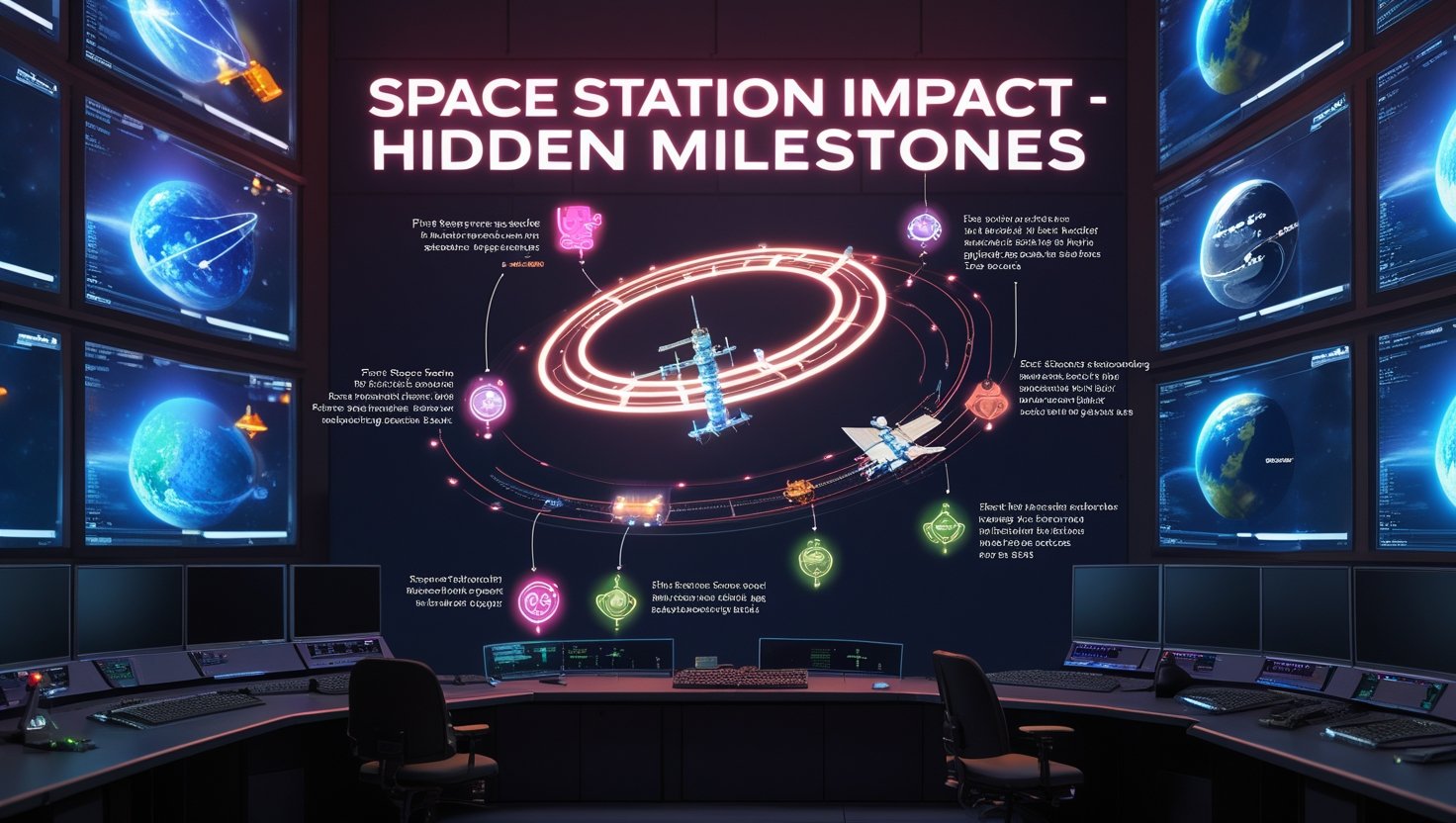
Imagine a place where humanity’s greatest leaps are born in the silence of orbit, a habitat that not only defies gravity but also transforms our understanding of science, diplomacy, and culture. The Space Station Impact is not merely about an outpost in space; it’s about a series of Hidden Milestones that have quietly reshaped our world. From groundbreaking experiments in microgravity to the forging of unprecedented international partnerships, space stations continue to spark innovations that drive progress on Earth. In this article, we delve into these overlooked triumphs, revealing how the space station has become a dynamic catalyst for change in ways that extend far beyond its physical boundaries.
The Genesis of a New Era:
The journey toward orbiting laboratories began as a bold experiment in human ingenuity. Early platforms set the stage for what would become a constellation of achievements. Historic projects like Skylab and later the International Space Station (ISS) were not built overnight; each represented a cumulative effort of decades of innovation, research, and sometimes, risk. These early endeavors laid the foundation for the Space Station Impact we witness today, serving as critical proving grounds for technologies in navigation, life support, and structural engineering.
Behind the scenes, many of these breakthroughs remained hidden from mainstream attention, categorized as subtle yet transformative Hidden Milestones. The modular design that allowed the assembly of complex living quarters in orbit, for example, revolutionized how engineers think about space construction. Every rivet and piece of circuitry was a stepping stone toward a future where space becomes an extension of human civilization.
As researchers and engineers collaborated on these projects, they not only solved immediate technical challenges but also opened up new possibilities for global cooperation. This quiet revolution in space architecture has become the touchstone for modern exploratory missions, proving that the lessons learned in orbit have enduring implications for life on Earth.
Scientific Breakthroughs in Orbit:
One of the most compelling narratives behind the Space Station Impact is the realm of microgravity research. In the weightlessness of space, scientific experiments defy terrestrial norms, revealing insights that often remain obscured on Earth. Laboratories in orbit allow researchers to study phenomena in an environment free from the interference of gravity. This has led to discoveries in materials science, biology, and medicine that have practical applications ranging from new drug formulations to enhanced manufacturing techniques.
For instance, experiments on bone density loss and muscle atrophy have not only improved our understanding of human physiology but have also led to therapeutic breakthroughs that benefit millions on Earth. These achievements are often the Hidden Milestones of space science, quiet revolutions that occur on the fringes of public consciousness yet drive forward medical innovation, robotics, and even environmental studies.
The extraordinary insights derived from microgravity research have altered how we approach problems as diverse as cancer treatment and sustainable materials production. In every experiment conducted on an orbiting laboratory, there lies the potential not only to answer age-old scientific questions but also to spark ideas that redefine technology and human capability.
Technological Innovations and Unseen Advancements:
Beyond the scientific laboratories, the Space Station Impact resonates through the technological advancements it has spawned. Innovations developed for space applications often find new life on Earth in unexpected ways, an enduring testament to the ingenuity fostered in orbit. Advanced robotics, renewable energy systems, and secure communication networks were all honed in the challenging environment of space, driven initially by the need to support life aboard a station orbiting 250 miles above Earth.
Many of these advancements began as carefully guarded projects with outcomes that remain among the Hidden Milestones of research and development. For example, miniaturized sensors and robust computing systems developed for monitoring space station environments have later been integrated into smart technologies across industries. The precision and reliability demanded by space missions laid the groundwork for innovations that increase efficiency and safety in sectors such as healthcare, transportation, and environmental monitoring.
Today, every new device, every breakthrough in remote sensing or digital connectivity, carries with it a legacy of engineering excellence inspired by the challenges and opportunities of space exploration. These invisible threads connect the space station with everyday life, underscoring an impact that is as broad as it is profound.
Unity and Collaboration Beyond Borders:
Perhaps one of the most understated aspects of the Space Station Impact is its role as a platform for international diplomacy. Orbiting high above Earth, space stations have served as neutral grounds where former adversaries come together with a common goal, exploring the unknown. In an era when geopolitical tensions often dictate terrestrial relations, the collaboration evident in projects like the ISS is a striking counterpoint, highlighting the possibilities of partnerships that rise above national differences.
The space station has become a symbol of unity, where scientists, engineers, and astronauts from diverse backgrounds work collectively to reach scientific and exploratory objectives. These partnerships are among the most significant Hidden Milestones, quiet, enduring legacies that underscore the power of collaboration. They remind us that when resources and talents are pooled in pursuit of knowledge, the resultant achievements can shape global perspectives and build bridges across cultures.
This orchestration of international talent not only fortifies our capabilities in space exploration but also nurtures a model for resolving conflicts and fostering communication on Earth. The diplomatic successes achieved in space continue to inspire new frameworks for shared ventures, redefining how nations collaborate toward common, visionary goals.
Inspiring Minds and Shaping Futures:
The imprint of the space station extends far beyond the realms of science and technology; it touches the very fabric of cultural identity and human aspiration. The milestones achieved in space have sparked imaginations around the globe, inspiring countless individuals to dream of a future where the limits of possibility are relentlessly pushed. This cultural resonance is one of the most potent aspects of the Space Station Impact, a quiet power that redefines society’s relationship with science and exploration.
Throughout history, monumental achievements in space have served as beacons of hope and catalysts for educational initiatives. The ISS and other human habitat projects in orbit have given rise to a generation of scientists, engineers, and dreamers who view the cosmos as the next frontier for human achievement. Documentaries, books, and public lectures continue to highlight these Hidden Milestones, weaving them into the narrative of progress and possibility.
The symbolic presence of a space station orbiting Earth has encouraged governments to invest in STEM education and research, thereby nurturing innovation at its roots. It’s a legacy that not only celebrates past accomplishments but also fuels the ambitions of future explorers. By instilling a sense of wonder and curiosity, the station serves as an inspiration for young minds to pursue careers that will one day carry humanity further into the cosmos.
Countdown to the Future:
As we navigate further into the 21st century, the legacy of space stations continues to evolve and expand. Looking forward, the Space Station Impact is set to become even more significant as emerging technologies and new missions propel us toward deeper space exploration. Future space habitats, enhanced by artificial intelligence, advanced materials, and real-time data analytics, promise to unlock further layers of Hidden Milestones that will shape both outer space and terrestrial industries.
The ongoing transition from pioneering projects like the ISS to next-generation platforms symbolizes a shift in how we coordinate exploration activities across multiple domains. The lessons learned in orbit, including precision engineering, real-time problem solving, and international cooperation, are now being integrated into global strategies for everything from climate monitoring to disaster response.
This evolving dynamic underscores the interconnected nature of progress, where breakthroughs in space technology cascade into myriad sectors of life on Earth. Every innovation, every experiment, which once seemed like a distant dream, serves as a stepping stone toward a future where space is not just a singular destination but a continuum of exploration and discovery. As new platforms take shape, they will continue to document and amplify a legacy of aspiration, ensuring that the Hidden Milestones of today become the celebrated triumphs of tomorrow.
Conclusion:
The Space Station Impact is a multifaceted journey defined by a tapestry of Hidden Milestones. From the birth of innovative laboratory methods in microgravity to the forging of unprecedented international alliances, the influence of orbiting habitats extends far beyond their physical structure. They are the quiet architects of change, transforming scientific inquiry, technological innovation, diplomatic relations, and cultural narratives. As we look toward the future, these achievements serve as a reminder that our greatest conquests often occur not in the spotlight but in the silent revolutions that shape our destiny.
FAQs:
Q1: What is meant by “Space Station Impact”?
It refers to the broad and lasting effects space stations have on science, technology, diplomacy, and culture.
Q2: What are “Hidden Milestones” in this context?
They are the lesser-known yet transformative achievements and breakthroughs that occur through space station projects.
Q3: How has microgravity research on space stations benefited Earth?
Experiments in microgravity have led to breakthroughs in medicine, materials science, and environmental research.
Q4: Why is international collaboration important on space stations?
Working together in orbit promotes unity, eases geopolitical tensions, and allows countries to share knowledge and resources.
Q5: In what ways have space station projects influenced technology on Earth?
Developments such as advanced robotics, sensor technologies, and improved communications originated from solving challenges faced in space.
Q6: How do space station achievements inspire future generations?
They spark curiosity and a passion for STEM fields, encouraging young minds to pursue careers in science and exploration.